For years, data center sustainability has largely been measured in watts, with Power Usage Effectiveness (PUE) serving as the industry’s primary benchmark. But as AI workloads push cooling systems harder than ever and water scarcity becomes a tangible operational risk, a second metric is moving to the forefront: Water Usage Effectiveness (WUE). For operators in tropical megacities facing increasing pressure on water resources, such as Jakarta, WUE is no longer just an ESG reporting metric—it has become a critical design constraint.
What Is Water Usage Effectiveness (WUE)?
Water Usage Effectiveness (WUE) measures how much water a data center consumes relative to the useful computing work performed by its IT equipment. The metric was introduced by The Green Grid in 2011 through White Paper #35, which established WUE as a companion metric to PUE. While PUE measures energy overhead and Carbon Usage Effectiveness (CUE) tracks emissions, WUE completes the third pillar of environmental impact: water consumption.
The reason is straightforward. Cooling systems almost always involve a trade-off between electricity and water. Evaporative cooling uses large volumes of water to remove heat while reducing electricity consumption, whereas closed-loop and air-cooled systems conserve water at the cost of higher energy use.
How WUE Is Calculated
The WUE calculation is simple: divide the total annual on-site water consumption (in liters) by the annual energy consumed by IT equipment (in kilowatt-hours).
WUE = Annual On-Site Water Usage (L) ÷ Annual IT Equipment Energy Consumption (kWh)
The result is expressed in liters per kilowatt-hour (L/kWh). Total on-site water usage includes water consumed for cooling, humidity control, and on-site power generation where applicable.
Industry averages typically range from 1.8 to 1.9 L/kWh, while best-in-class facilities operate at 0.2 L/kWh or lower—less than a cup of water for every kilowatt-hour of IT energy consumed.
Why WUE Is Becoming Increasingly Important
AI is the primary driver behind the growing importance of WUE. High-density AI clusters generate significantly more heat per rack, and more heat inevitably requires more cooling.
According to the International Energy Agency’s analysis of AI-related energy and water demand, data centers worldwide consume approximately 560 billion liters of water annually, with demand projected to reach 1.2 trillion liters by 2030. A typical 100 MW facility may consume around two million liters of water per day. This is why questions about whether AI growth can coexist with clean energy and responsible water management have become central to infrastructure planning.
Measurement remains one of the industry’s weakest links. Research from the Uptime Institute on water, circularity, and site selection found that fewer than half of data center operators actively monitor their water consumption. The report recommends publishing annual disclosures covering total water usage, average daily consumption, and peak daily demand. Operators that cannot report their WUE cannot credibly claim to manage it.
The Trade-off Between PUE and WUE
WUE should never be evaluated in isolation because it often moves in the opposite direction of the industry’s most familiar efficiency metric.
Evaporative cooling achieves excellent PUE by relying heavily on water, resulting in higher WUE. Conversely, closed-loop and air-cooled systems minimize water consumption but generally require more electricity. As a result, strategies designed to reduce data center electricity costs and improve energy efficiency are not necessarily the same strategies that minimize water use.
Truly sustainable facilities optimize both metrics simultaneously, selecting cooling technologies based on local climate conditions and water availability rather than chasing a single performance indicator.
Why WUE Matters So Much in Jakarta
Jakarta makes the water challenge impossible to ignore.
Decades of excessive groundwater extraction have contributed to severe land subsidence, with parts of North Jakarta sinking by several centimeters each year. Facilities that rely heavily on evaporative cooling using municipal or groundwater supplies face not only environmental concerns but also increasing regulatory and reputational risks.
The tropical climate further complicates the equation. High temperatures and consistently high humidity increase baseline cooling requirements while limiting opportunities for free-air cooling. As a result, operators may be tempted to adopt water-intensive cooling systems simply to maintain low PUE values.
Responsible operators in Jakarta instead treat WUE as a primary design objective from day one.
Strategies for Reducing WUE
Improving WUE ultimately comes down to cooling system design and water sourcing. The most effective strategies include:
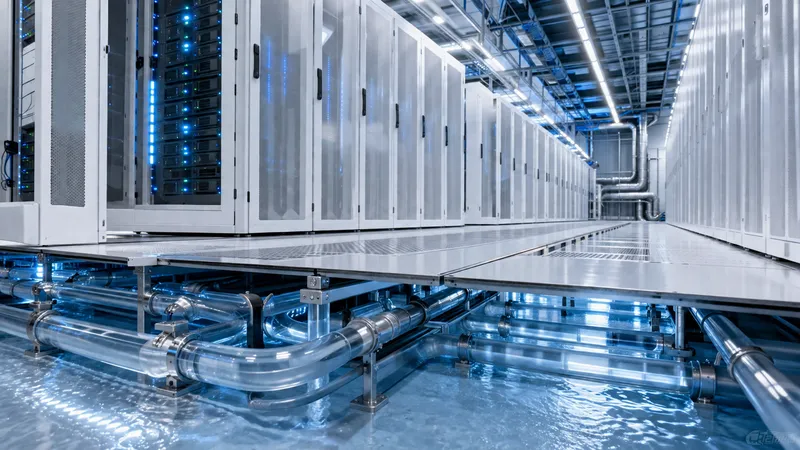
- Closed-loop and air-cooled systems, which continuously recirculate water or reject heat directly into the air, eliminating the need for continuous evaporative makeup water.
- Direct-to-chip liquid cooling and immersion cooling, which remove heat from high-density AI hardware far more efficiently while reducing both energy and water consumption per unit of computing.
- The use of recycled or non-potable water, ensuring that cooling operations do not compete with drinking water supplies.
- Climate-aware site selection and facility design, matching cooling technologies to local temperature, humidity, and water availability.
Innovation across all of these areas is accelerating, and the industry’s shift toward liquid cooling and water-efficient technologies continues to reshape how high-density data centers manage heat without relying on continuous water consumption.
How Digital Edge Indonesia Manages Water Efficiency
Digital Edge Indonesia incorporates both energy efficiency and water conservation into the design and operation of its facilities as part of its broader commitment to sustainable data center practices.
These principles are more than just aspirations. EDGE2 has earned LEED Gold certification, a globally recognized standard whose credit framework explicitly rewards reductions in water consumption. As discussed in the role of LEED certification in advancing green data centers, the value of LEED lies in its ability to validate sustainability claims against independently audited benchmarks. Digital Edge also publicly reports its environmental performance through its 2026 ESG Report on sustainable data center solutions across Asia Pacific.
For enterprises, lower WUE translates into more resilient infrastructure. Choosing colocation services in a water-efficient facility in Jakarta helps reduce exposure to growing resource constraints while avoiding the risks associated with water-intensive operations. The Digital Edge Jakarta data center campus is designed to deliver both energy and water performance that supports long-term sustainability objectives.
Conclusion
Water Usage Effectiveness has evolved from a rarely discussed metric into one of the defining measures of responsible data center operations. As AI continues to increase cooling demand and water becomes an increasingly constrained resource, optimizing energy efficiency alone is no longer enough to claim sustainability.
The operators that will earn the trust of enterprises and regulators are those that measure WUE transparently, design cooling systems around local water realities, and validate their performance through independent standards.
In cities like Jakarta, where every liter of groundwater carries long-term consequences, managing WUE effectively is no longer optional—it is essential to operating responsibly and credibly.
Looking for a sustainable colocation provider in Jakarta? Contact the Digital Edge Indonesia team to learn how our water-efficient cooling strategies and WUE-focused design support your organization’s long-term sustainability goals.