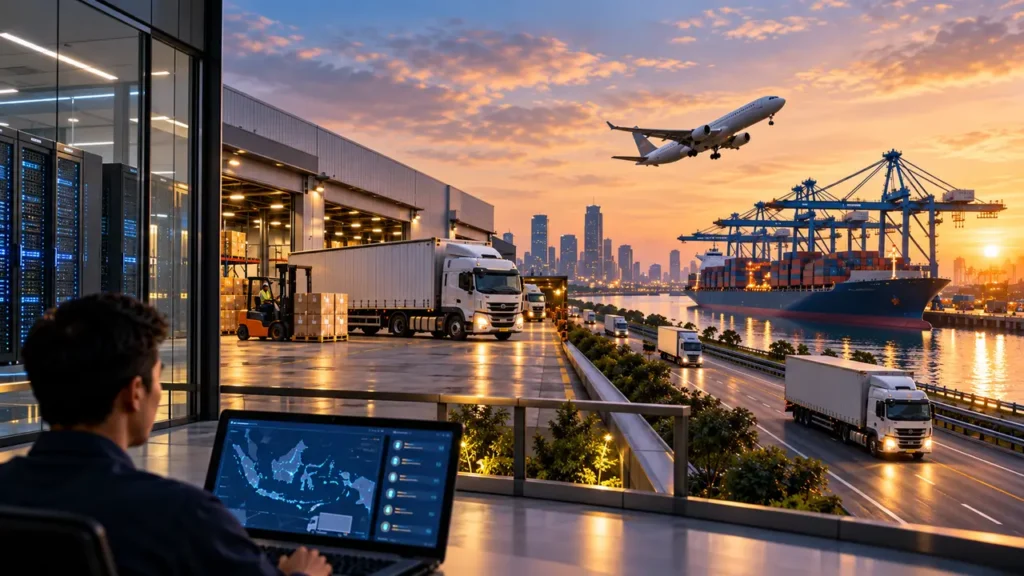
Logistics businesses once depended primarily on trucks, warehouses, and people. Those remain essential, but today nearly every movement is coordinated by software. Orders enter through digital systems, warehouse staff pick goods based on system instructions, drivers follow routes through apps, and customers track their packages online.
That makes the systems supporting logistics operations just as important as the fleet itself. When systems slow down, warehouse operations slow with them. When systems go offline, deliveries can come to a halt. This is why logistics companies need to reconsider where their core systems are hosted and whether an office server room is still sufficient.
This article looks at the system requirements of different logistics segments, from ride-hailing to sea and air cargo, the practical benefits of data centers for logistics companies, and the questions to ask before choosing a provider.
Logistics Operations Now Run on Software
Shipping volumes in Indonesia continue to grow alongside the digital economy. The e-Conomy SEA 2025 report estimates that Indonesia’s e-commerce gross merchandise value will reach around US$71 billion in 2025, while online transport and food delivery services are expected to reach approximately US$10 billion. Almost every e-commerce transaction ultimately results in a physical delivery handled by a logistics provider.
Each logistics segment depends on a different set of critical systems:
- Ride-hailing and on-demand delivery: real-time driver and order matching, driver apps, and payment processing
- Courier services, 3PL, and warehousing: order systems, warehouse management, and shipment tracking for customers and marketplaces
- Ground transport and trucking: transportation management systems, route planning, GPS-based fleet monitoring, and digital proof of delivery
- Sea freight: data exchange with shipping lines and terminal operators, shipping documentation, and integration with customs and port systems
- Air cargo: cargo booking, air waybill documentation, and highly time-sensitive customs processes
Despite these differences, they all share the same requirements: systems need to be available 24/7, fast to access from across Indonesia, and reliably connected to partners. Systems within the same company are also highly dependent on one another. If the order management system goes down, warehouse staff may not have a list of goods to pick. If the tracking system becomes unavailable, customer service teams can quickly be overwhelmed with calls.
For international sea and air freight, shipment visibility remains a challenge. The World Bank’s latest Logistics Performance Indicators 2.0 2025 shows that shipping times and reliability still vary across countries and routes. For logistics companies, this reinforces the importance of systems that can reliably exchange data with carriers, terminals, customs authorities, and other partners.
Why Office Server Rooms Are No Longer Enough
Many logistics companies begin with servers located in a back room at their head office or main warehouse. This setup may be sufficient while the business is small. As shipping volumes increase, however, its limitations can become increasingly costly.
Power. Office buildings may have backup generators, but they rarely provide the multiple layers of protection required by mission-critical systems. Even a brief power interruption can make systems unavailable, while bringing them back online in the correct sequence can take time.
Cooling. Server rooms often depend on the same air-conditioning systems used by the rest of the building. If the cooling system fails overnight or during a weekend, equipment can overheat.
Flooding and location risks. Warehouses and depots are usually selected based on road access and land costs rather than their ability to protect IT equipment. Climate and data center location risks in Jakarta, particularly flooding, also apply to server rooms located inside warehouses.
Operations teams. Keeping a server room running around the clock requires staff who are prepared to respond to problems at three in the morning. Most logistics companies would rather have their IT teams focus on developing systems that improve operations.
The financial impact of failing to address these risks can be significant. According to the Uptime Institute Annual Outage Analysis 2026, 57% of survey respondents said their most recent significant outage cost more than US$100,000, while one in five reported costs exceeding US$1 million. Power remains the leading cause of serious outages. For logistics companies, direct costs are only part of the impact. Missed delivery schedules and declining customer trust can have longer-lasting consequences.
Benefits of Data Centers for Logistics Companies
Moving systems into a data center directly addresses many of these limitations. Companies typically use colocation, where they place their own equipment inside a professionally managed facility.
Systems Stay Available
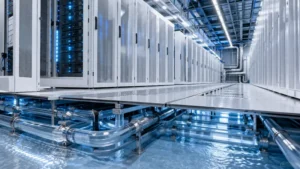
Tier III data centers are designed so that electrical and cooling equipment can be maintained or replaced without shutting down customer systems. Multiple power paths, backup batteries, and generators work together to prevent utility power failures from affecting your servers.
For logistics companies, this means order intake, driver dispatch, and shipment tracking can continue during night shifts, public holidays, and even the height of the rainy season.
Physical Security
Access is controlled, logged, and monitored around the clock. Only authorized personnel can physically access your equipment.
This protection matters because logistics systems store customer addresses, shipment information, and partner data. Customers’ personal data is also protected under Indonesia’s Law No. 27 of 2022 on Personal Data Protection.
Room to Scale for Peak Seasons
Logistics volumes are rarely consistent throughout the year. Harbolnas, Ramadan, and year-end shopping periods can cause shipping volumes to rise sharply over a short period.
In a data center, additional capacity can be installed in infrastructure that was designed for expansion rather than trying to squeeze another server into an already crowded room. Growth is easier to plan when you have a clear understanding of data center capacity planning: how much space and power you need today, and how much you are likely to need in two or three years.
24/7 On-Site Support
Data center staff can handle routine physical tasks such as checking equipment, replacing cables, and restarting devices. This means your IT team does not need to remain on call for every hardware issue.
Why Location in Jakarta Matters
For logistics companies, data center location affects both performance and connectivity.
Faster applications for drivers and customers. Driver apps, tracking pages, and partner systems respond faster when servers are located closer to their users. If most of your users are in Indonesia, hosting systems in Jakarta avoids the additional delay created when every request has to travel to another country and back.
Better connectivity to partners. Logistics businesses depend on constant connectivity between multiple parties. Your systems exchange data with marketplaces, e-commerce platforms, banks and payment providers, customs systems, port and airport cargo operators, and other transportation providers. A carrier-neutral data center provides access to multiple network providers within the same facility, allowing you to connect reliably to partners and switch providers without moving your equipment.
Choosing the right location. Different systems have different location requirements. Systems that constantly communicate with customers and partners benefit from being located in central Jakarta, close to major network exchange points. Larger workloads or systems that are less sensitive to response times can be placed in data center campuses outside the city. The advantages and trade-offs of each approach are covered in more detail in our guide to choosing a data center location in Indonesia.
Colocation or Cloud?
Many logistics companies already use cloud services. The question is often not whether to use cloud or colocation, but which systems belong where. In practice, many companies use a combination of both.
Colocation tends to suit systems that run continuously with predictable workloads, such as order management, warehouse management systems, transportation management systems, and tracking databases. For these workloads, owning the hardware and paying a fixed monthly fee for space and power may be more economical over several years than paying cloud rates around the clock, depending on the workload profile. You also retain full control over the hardware and where the data is stored.
Cloud tends to suit short-lived or highly variable workloads, such as application testing, seasonal analytics, or additional capacity needed to handle unusually large spikes in demand.
A data center with direct connectivity to cloud providers allows you to run both side by side: keeping core systems in colocation while adding cloud capacity when needed. For ride-hailing and on-demand delivery platforms that already rely heavily on cloud infrastructure, colocation can complement rather than replace the cloud by serving as an interconnection point for partners, network providers, and cloud platforms.
Questions to Ask a Data Center Provider
Before selecting a facility, logistics companies should get clear answers to the following questions:
- How is the facility designed for reliability? Ask about its Tier level and redundancy for power and cooling.
- Where exactly is the facility located, and what are the location risks? Ask about flood history and site elevation.
- Which network providers are available in the building? More choice can mean better pricing and more options for redundant connectivity.
- Can you connect directly to partners and cloud providers? This affects the speed and reliability of every integration.
- How quickly can you add more space and power? Make sure the facility can support business growth and seasonal peaks.
- What can the on-site team handle for you? Clarify which physical tasks are included and how quickly the team can respond.
- What is included in the contract? Understand which costs are fixed, which may change, and how long the contractual commitment lasts.
Conclusion
Logistics operations in Indonesia now move at the speed of their software. Driver dispatch, order intake, warehouse operations, route planning, cargo documentation, and shipment tracking all depend on systems that need to remain available every hour of every day, including the busiest periods of the year. Office server rooms were not designed to carry that level of responsibility.
Professional data centers provide reliable power and cooling, physical security, room to expand ahead of peak seasons, and direct connectivity to data exchange partners. Hosting these systems in Jakarta also places them closer to drivers, customers, and the networks that connect the logistics ecosystem.
For companies expecting shipment volumes to continue growing, moving to a professional data center is not simply an IT decision. It is part of ensuring that delivery promises can still be met as the business scales.
CTA: If your logistics operations have outgrown the capabilities of your current server room, consider Digital Edge Indonesia’s colocation services in Jakarta and learn how EDGE2 can help keep your logistics systems running through every peak season.