If you run managed services — hosting, private cloud, backup, disaster recovery, or security operations — your customers are trusting you with their uptime. Behind every SLA you sign is a data center you depend on.
For many managed service providers in Indonesia, that dependency sits in a single facility. The platform grew there, the customers were onboarded there, and the network was built around it. It works — until the day that one building, one power path, or one fiber route has a problem.
This guide explains what managed service providers should look for in a data center, why a single site eventually becomes a business risk, and how to choose and connect a second site so your services stay available even when one location doesn’t.
Why Managed Services Raise the Bar
An enterprise running its own systems carries its own risk. A managed service provider carries the risk of every customer on its platform at once.
That changes the requirements in three ways:
- Your SLA is only as strong as your facility’s. If you promise customers 99.95% availability, the data center underneath has to deliver better than that — with room to spare for your own maintenance and incidents.
- Your customers inherit your compliance posture. Banks, insurers, and regulated businesses will ask where their data lives, who can access it, and how it is protected. Your data center’s controls become part of your answer.
- One outage affects many customers. A single incident can trigger SLA credits, support escalations, and churn across your entire customer base at the same time.
Power and facility failures are still the leading cause of impactful outages, according to Uptime Institute’s Annual Outage Analysis 2026. The same research notes that outages linked to fiber and connectivity are rising and tend to last longer. For a provider whose business is availability, both risks matter.
What to Look for in a Data Center for Managed Services
Whether you are choosing your first facility or your second, these are the criteria that matter most for a managed services business.
1. A resilient, maintainable facility
Look for a facility designed so that power and cooling can be maintained without shutting down your racks — the core idea behind a Tier III design. Ask about the redundancy of each system (utility feeds, generators, UPS, and cooling) and how the power SLA differs for dual-corded and single-corded equipment.
2. Carrier neutrality and connectivity choice
Managed services are delivered over the network. A carrier-neutral data center lets you choose from many network providers, negotiate better pricing, and build diverse upstream paths. Access to an internet exchange in the same building shortens the route to your customers’ networks.
3. Reach to your customers and partners
Many managed service customers want private connectivity rather than the public internet. Check whether the facility can provide cross-connects to your customers’ carriers, metro links to other data centers, and private connections to public cloud providers for hybrid services.
4. On-site support that matches a lean team
Most managed service providers don’t keep engineers on site around the clock. A strong remote hands service — with a clear response time and defined scope — lets you handle hardware swaps, cabling, and reboots without sending staff across Jakarta in the middle of the night.
5. Security and compliance you can pass on
Ask for the facility’s certifications and their scope, its physical security layers, its access-control process, and how it supports customer audits. Your customers’ auditors will eventually ask you the same questions.
6. Room to grow — and a contract that allows it
Managed services grow customer by customer. Look for flexible terms that let you add racks or power as you onboard new accounts, without renegotiating from scratch.
When One Site Is No Longer Enough
A single data center is a reasonable place to start. It becomes a business risk when one or more of the following is true:
- You sell high-availability or DR services. It is difficult to sell disaster recovery to customers when your own platform has no recovery site.
- Your customers are regulated. Financial services customers in Indonesia work under OJK requirements for data center and disaster recovery arrangements, set out in regulations such as POJK 11/POJK.03/2022 on IT governance for commercial banks. Our guide to how OJK regulates disaster recovery centers explains what this means in practice. Note that a recovery site for regulatory purposes is usually expected to sit in a different risk zone from the primary site, so confirm requirements with your customers’ compliance teams before treating a metro site as their DR site.
- Your SLAs have outgrown your facility. If your contractual commitments are close to — or higher than — the availability of the building you run in, you have no margin for error.
- Your customer contracts are getting larger. Enterprise buyers increasingly ask, during procurement, where the second site is.
- A near-miss has already happened. A power event, a fiber cut, or a maintenance incident that almost took services down is usually the clearest signal.
How to Choose the Second Site
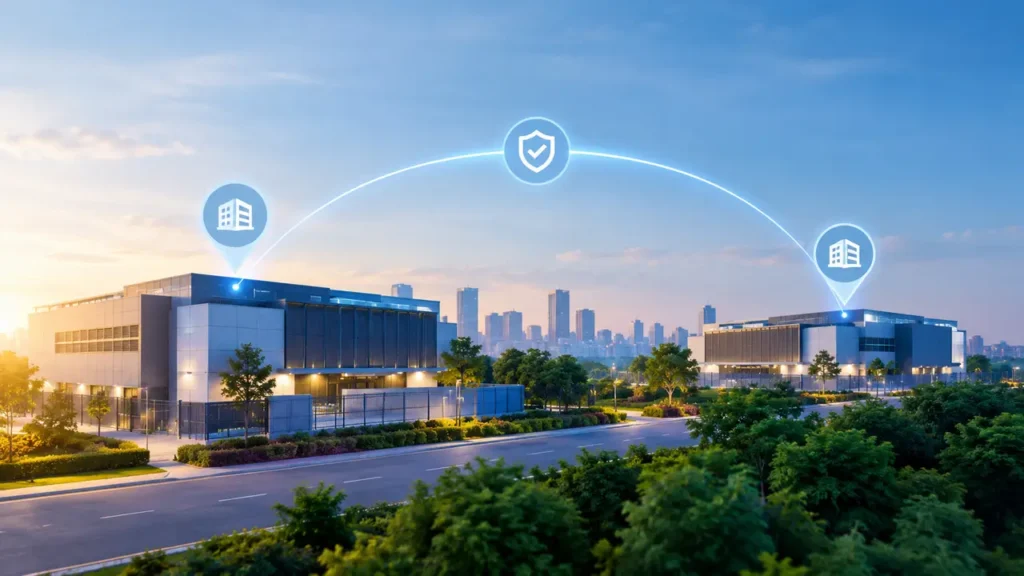
The second site is not just “another data center.” Its value comes from how independent it is from the first — while still being close enough to work as one platform.
Separate the risks, not just the buildings
The two sites should not share the same single points of failure. Check that they:
- Draw power from different utility feeds or substations where possible
- Use different fiber routes and entry points, so one cable cut can’t isolate both
- Sit in locations with different site risk profiles — flood exposure, elevation, and access routes. Our article on data center site risk in Jakarta covers what to evaluate.
- Are not dependent on the same single carrier for connectivity
Know whether you’re building for availability or for recovery
A second site can do two different jobs, and they pull in opposite directions on distance.
- High availability (HA): keeps services running through a facility-level failure, ideally with no data loss. This needs synchronous replication, so the sites must be close — typically within the same metro, with round-trip latency of a few milliseconds.
- Disaster recovery (DR): restores services after a regional event such as a major flood, a grid failure, or an earthquake. That needs geographic distance, which means asynchronous replication and some accepted data loss (your recovery point objective, or RPO).
A metro second site strengthens availability, but it may not satisfy a regulator or auditor looking for a recovery site in a different risk zone. Many regulated platforms end up with both: two metro sites for HA, plus a remote site for DR.
| Metro second site (HA) | Out-of-region site (DR) | |
| Protects against | Building, power, or fiber failure | Regional events such as floods, grid failures, or earthquakes |
| Replication | Synchronous | Asynchronous |
| Typical data loss (RPO) | Near zero | Minutes to hours |
| Fit as a regulatory DR site | Confirm with your customers’ auditors | Usually the intended purpose |
Decide on the operating model
| Model | How it works | Best for |
| Active-passive | The second site holds replicated data and standby capacity, and takes over during a failure | Backup and DR services, cost-sensitive platforms |
| Active-active | Both sites serve live traffic, and either can carry the full load alone | High-availability hosting, customer-facing platforms with strict SLAs |
| Split by service | Some services run primarily in each site, each backing up the other | Growing providers balancing cost and resilience |
Whichever model you choose, size the second site to carry the critical load on its own — otherwise it is a backup in name only.
Connecting the Two Sites
The link between your two facilities is as important as the facilities themselves. If it fails, replication stops and failover becomes risky.
Best practices for the inter-site connection:
- Use dedicated metro connectivity, not the public internet, for replication and management traffic.
- Build in path diversity. Two links over physically separate routes protect against a single fiber cut. Our guide to network redundancy in data centers explains the principles.
- Size bandwidth for recovery, not just replication. After an outage, the link may need to resynchronise large volumes of data quickly.
- Keep upstream connectivity at both sites. Each site should be able to reach the internet and your customers independently, with routing that shifts traffic automatically if one site goes dark.
- Test failover regularly. A DR design that has never been exercised is an assumption. Schedule controlled failover tests and record the results for your customers and auditors.
Where EDGE2 Fits
For managed service providers already colocated elsewhere in Jakarta, EDGE2 in Kuningan is suited to the high-availability role: a separate building in the city centre, with its own power and fiber infrastructure, close enough to your existing site for synchronous replication. For regulatory disaster recovery, pair it with an out-of-region site.
Digital Edge Indonesia’s EDGE2 in Kuningan is a carrier-neutral facility with a Tier III design, 2N power, and a 100% power SLA. Cross-Link provides metro connectivity between Digital Edge facilities and other strategic locations in the same metro, at 1, 10, or 100 Gbps, with protected or dual-diverse options — the kind of inter-site link a dual-site design depends on. A 24/7 remote hands service supports the second site without the need for permanent on-site staff.
Conclusion
For a managed service provider, the data center is part of the product. The right facility combines resilient power and cooling, carrier-neutral connectivity, reach to customers and partners, dependable on-site support, and the security posture your customers’ auditors expect.
As your platform and SLAs grow, a single site becomes the largest risk in your business. A well-chosen second site — independent in power, fiber, and location, yet close enough for real-time replication, and connected through diverse metro links — lets you offer the availability your customers are paying for, and prove it when they ask.
Already colocated in Jakarta and planning a second site? Talk to our team about adding redundancy at EDGE2 and connecting it to your existing facility with Cross-Link.