Most data center due diligence starts with the tier rating and the uptime SLA. In Jakarta, that is only half the story. The other half is the ground the facility stands on — a coastal megacity that floods every wet season, sinks measurably each year, and sits inside one of the world’s most seismically active regions. For any deployment in the capital, physical site risk belongs in the evaluation alongside power and connectivity, because no amount of redundant UPS protects a data hall that takes on water. This guide walks through the climate and geological risks specific to Jakarta and the design and recovery choices that mitigate them.
Why does physical site risk deserve as much attention as uptime tiers?
A tier rating describes the redundancy of a facility’s power and cooling systems; it says nothing about whether the building is on a floodplain, on subsiding ground, or near an active fault. Those are site-level questions, and in Jakarta they are decisive. The most resilient electrical topology in the world cannot compensate for a ground floor that floods or a structure stressed by differential settlement. Reading site risk and infrastructure resilience together is exactly what separates a genuinely dependable facility from one that merely looks robust on paper — the same logic behind the broader characteristics of a reliable data center.
How serious is land subsidence in Jakarta — and why does it matter?
Jakarta is one of the fastest-sinking coastal cities on earth. Parts of North Jakarta have subsided on the order of 10 cm or more per year in recent decades, driven largely by excessive groundwater extraction compacting the aquifers beneath the city, as documented in peer-reviewed analysis of Jakarta’s land subsidence. For a data center, subsidence is not an abstract environmental statistic. It lowers a site’s effective elevation relative to sea level and rivers year after year, worsening flood exposure over the life of a 15-to-20-year lease, and uneven settlement can stress slabs, conduits, and raised-floor systems. The government’s groundwater-free-zone policy and coastal defences are slowing the trend, but site elevation and the local subsidence profile should be verified, not assumed.
What does flood risk mean for facility design?
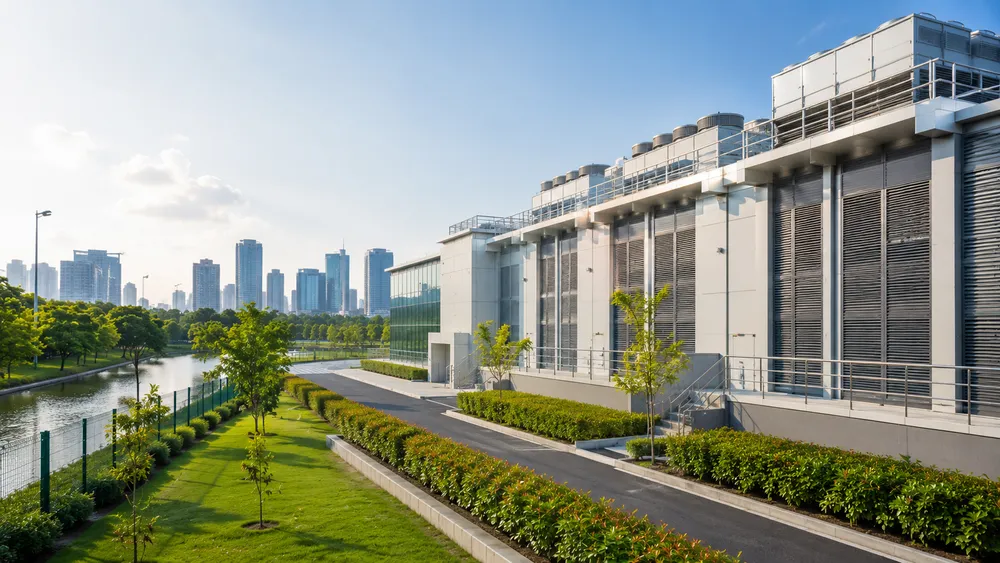
Jakarta’s flood season runs through the monsoon months, and the city contends with both river flooding from upstream and tidal flooding along its subsiding northern coast. The design responses are well understood but have to be confirmed for each site: locating critical plant and electrical rooms above the ground floor rather than in basements, raised equipment plinths, building entries above the modelled flood line, waterproofing and water-tight barriers, and pumping and drainage with its own redundancy. Site selection is the first and cheapest control — which is part of why location matters when choosing a Jakarta data center. A facility on higher ground, away from known flood basins, starts the resilience conversation from a far stronger position.
How exposed is the region to seismic activity?
Indonesia sits on the Pacific Ring of Fire, and Java carries real seismic exposure from both distant subduction-zone megathrust events and nearer crustal faults. Jakarta’s shaking risk is moderate compared with some Indonesian regions, but soft alluvial soils can amplify ground motion, so seismic design cannot be treated as an afterthought. The mitigations are structural: building to current Indonesian seismic standards (SNI) and equivalent international codes, anchoring and bracing racks and mechanical plant, and using flexible connections on pipework and conduit so that a tremor does not sever the systems that keep a data hall alive.
How does climate change raise the stakes over the life of a lease?
Every one of these hazards is trending in the wrong direction. Rainfall is becoming more intense, sea levels are rising against an already-subsiding coastline, and higher ambient temperatures add stress to cooling systems. The Uptime Institute’s analysis of climate change and data center resiliency argues that operators must re-evaluate site resilience against forward-looking climate scenarios rather than the historical record, because a site that was comfortably above the flood line a decade ago may not be in fifteen years. Climate risk is a lease-duration question, not a point-in-time one.
Where do disaster recovery and site pairing fit?
Because no single site can be engineered to zero risk, resilience in Jakarta is also an architecture question. The standard answer is to pair a primary facility with a recovery site that has a genuinely different hazard profile — sufficient separation that one flood, one tremor, or one grid event cannot take both down at once. That pairing should be backed by a disaster recovery plan with tested failover, and by disciplined operational practice for handling data center downtime when an event does occur. For regulated sectors such as financial services, site pairing is not optional — it is a supervisory expectation.
What should a site-risk due-diligence checklist include?
When evaluating a Jakarta site or provider, the questions that actually surface physical risk are concrete:
- What is the site elevation relative to the floodplain, and is there current topographic flood modelling — not just historical flood maps?
- What is the local subsidence rate, and is the site inside or outside the regulated groundwater-free zone?
- Where are critical electrical and mechanical rooms located — above grade, or in basements exposed to ingress?
- To which seismic standard is the structure designed, and how are racks, plant, and pipework anchored against ground motion?
- What is the disaster-recovery pairing — how far is the recovery site, and does it carry a different flood and seismic profile?
Conclusion
In Jakarta, the ground is part of the infrastructure. Subsidence, monsoon and tidal flooding, and seismic exposure are not edge cases — they are baseline conditions that a credible facility has to be sited and engineered against, and that climate change is steadily intensifying over the length of a typical lease. The operators worth trusting can show their work: elevation and flood modelling, a known subsidence context, seismic design to current codes, and a disaster-recovery pairing with a genuinely independent risk profile. Evaluate the site with the same rigour you bring to the power and the tier rating, and the capital’s hazards become a managed variable rather than a hidden liability.
If you are assessing site risk for a Jakarta deployment, talk to the Digital Edge Indonesia team about facility elevation, flood and seismic design, and disaster-recovery site pairing across our Jakarta campuses.