In today’s highly connected world, we have entered an era where data plays a central role in modern business operations. Data is being generated and consumed at an unprecedented rate — from video streaming and online gaming to smart sensors, Internet of Things (IoT) deployments, and Artificial Intelligence (AI)-driven analytics.
By collecting and analyzing data accurately, businesses can gain insights to tailor services more closely to customer needs and behaviors. However, the massive volume of data being processed every day requires infrastructure that is fast, reliable, and efficient. This is where edge computing and edge data centers come in, transforming how digital services are delivered and experienced.
For applications that are sensitive to millisecond-level delays, understanding low latency is essential when designing network architecture. In any interconnection strategy, an internet exchange also plays an important role in reducing latency and making traffic flows more efficient.
But what exactly are edge computing and edge data centers? Let’s break it down.
Model Traditional vs. Edge Approach
Traditionally, data centers are large, centralized facilities that are often located far from the end users they serve. When you access an online service or send data from an IoT device, that data usually has to travel long distances to a central data center for processing before the response is sent back.
While this model has served businesses well for many years, it also creates several challenges as data volumes continue to rise:
- Latency: Delays in data transfer can lead to lag, slow loading times, and poor user experiences, especially for real-time applications.
- Bandwidth Inefficiency: Sending large amounts of data back and forth to centralized facilities can consume significant bandwidth, increase congestion, and raise transmission costs.
- Data Sovereignty and Security: Certain industries and use cases require data to be processed and stored within specific local or geographic boundaries.
What Is Edge Computing and an Edge Data Center?
Edge computing is a distributed computing framework that places compute and storage resources closer to the source of data or the end user. In simple terms, it shifts part of the processing workload away from a centralized data center and closer to where the data is created or used.
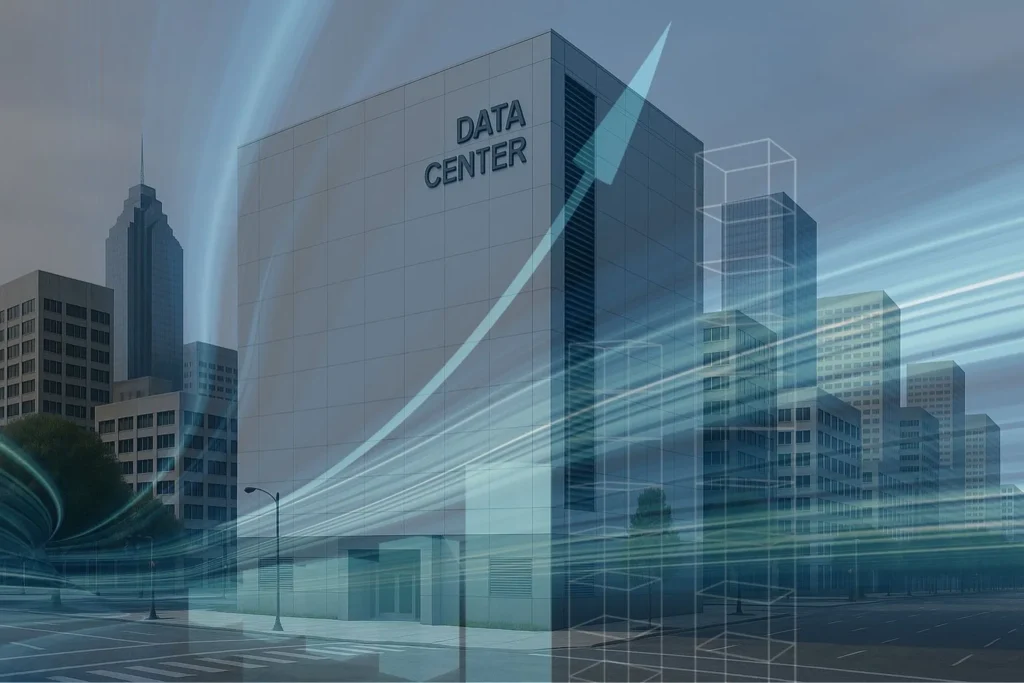
An edge data center, meanwhile, is the physical facility that supports this model. It is a smaller, localized data center strategically positioned at the “edge” of the network so that it is closer to the devices and users generating or consuming data.
Instead of sending all data to a distant central cloud, an edge data center enables local processing for faster response times and more efficient operations. These facilities may be deployed in many environments, including factory floors, retail locations, cellular tower sites, or dedicated metro and regional facilities.
Key Benefits of Edge Infrastructure
Combining edge computing with edge data center infrastructure delivers several major advantages:
- Significantly Lower Latency: By processing data closer to its source, network delay is minimized. This is especially important for real-time technologies such as autonomous vehicles, connected rail systems, online gaming, industrial robotics (IIoT), and Augmented Reality (AR) or Virtual Reality (VR).
- Improved Bandwidth Efficiency: Processing data locally reduces the amount of information that needs to be sent back to a central cloud. This helps lower bandwidth usage, reduce costs, and ease network congestion.
- Greater Reliability and Resilience: A distributed network of edge sites can provide stronger operational resilience. If one node experiences an issue, other nodes may continue supporting local services.
- Scalability and Flexibility: Businesses can scale their IT infrastructure more strategically by adding capacity in specific locations where demand is growing.
- Enhanced Data Security and Sovereignty: Local processing can reduce data exposure during long-distance transmission and help organizations meet data sovereignty requirements, including those relevant in Indonesia.
The Role of Data Centers in the Era of Edge-to-Cloud Computing
One of the biggest challenges in adopting edge computing successfully lies in the underlying IT infrastructure. Businesses still need robust data center capacity close to end users in order to store, manage, and support workloads effectively.
That is why the concept of edge-to-cloud computing has become increasingly important. This hybrid approach allows large-scale data to remain stored and processed in core cloud or centralized data centers for broader analysis and long-term workloads, while time-sensitive processing happens at the edge in real time.
When implemented successfully, edge-to-cloud computing gives organizations greater flexibility, scalability, and operational efficiency.
Why Edge Data Centers Matter for Indonesia
Indonesia is particularly well positioned to benefit from edge infrastructure. With its fast-growing digital economy, vast archipelagic geography, and rising adoption of smart technologies, bringing data processing closer to local businesses and consumers can create major advantages, including:
- Faster access to digital services for better user experiences
- Stronger support for local innovation in smart cities, e-commerce, and digital manufacturing
- Improved growth and reach of the digital ecosystem across the archipelago
The Future Is at the Edge
Edge data centers are not just a passing trend — they represent a fundamental shift in how digital infrastructure is designed and deployed. As dependence on real-time data and connected devices continues to grow, bringing compute power closer to users will become even more important.
Ready to unlock the power of low-latency, high-performance data processing for your business in Indonesia? Discover Digital Edge Indonesia solutions today and gain your competitive advantage.