A data center is a dedicated building or facility that houses servers, storage, and network equipment, together with backup power, cooling, and layered security, to store, process, and deliver data and applications around the clock. Almost every digital service, from mobile banking and online shopping to streaming and AI applications, runs from a data center.
Demand keeps growing. According to ITU Facts and Figures 2025, around 6 billion people now use the internet, and the APJII 2025 survey counted 229.4 million internet users in Indonesia. Add the rapid growth of AI, and data centers have become one of the most important types of infrastructure today.
Definition of a Data Center
Put simply, a data center is the “home” of IT infrastructure. It can be anything from a small server room in an office to a hyperscale campus with tens of thousands of racks.
What separates a professional data center from an ordinary server room is reliability. Every critical component has a backup (redundancy), so services keep running even when one part fails or is under maintenance.
Key Functions of a Data Center
- Storing data securely and centrally, at large volume.
- Processing data and running applications, including training and running AI models on GPU servers.
- Connecting networks. Telecom operators, internet providers, cloud platforms, and enterprises interconnect inside data centers, especially carrier-neutral ones.
- Keeping businesses running, including as a disaster recovery site.
- Protecting data and supporting compliance with regulations such as Indonesia’s personal data protection law (UU PDP).
How Does a Data Center Work?
When you open an app, your request travels over the internet to a server in a data center. The server processes it, retrieves data from storage, and sends the result back, often within milliseconds. That process relies on:
- Servers, storage, and network equipment that process and move the data.
- Power systems: the utility supply, a UPS that bridges the seconds after a power cut, and generators for longer outages.
- Cooling that keeps the air entering the equipment within ASHRAE’s recommended range of roughly 18–27°C.
- Physical security: 24/7 guards, CCTV, mantraps, and biometric access.
For more detail, see our guide to data center components.
What Does a Data Center Look Like?
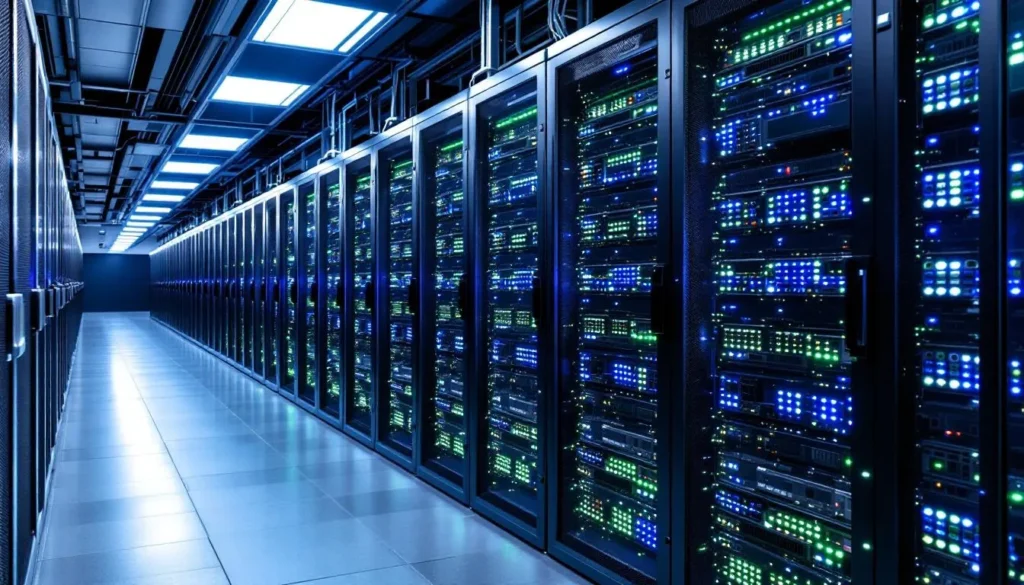
From the outside, a data center looks like a closed building with few windows and tight security. Inside are data halls lined with server racks, electrical rooms for UPS systems and batteries, generators, a meet-me room where carriers’ networks interconnect, and a control room (NOC) that monitors everything 24 hours a day.
Types of Data Centers
- Enterprise data center: built and run by a company for its own use.
- Colocation data center: a company rents space, power, cooling, and security, while owning its servers.
- Hyperscale data center: massive facilities for cloud providers and AI platforms. Global hyperscale capacity is expected to almost triple within six years.
- Cloud data center: owned by public cloud providers; customers rent virtual resources. See data center vs. cloud.
- Edge data center: smaller facilities placed close to users to reduce latency.
Conventional Data Center vs. AI Data Center
An AI data center is a data center designed for very high-power GPU servers.
| Aspect | Conventional data center | AI data center |
|---|---|---|
| Main equipment | CPU-based servers | GPU servers and AI accelerators |
| Power per rack | A few to around 15 kW | Tens of kW to over 100 kW |
| Cooling | Mainly air cooling | Liquid cooling increasingly required |
| Workloads | Business apps, web, databases | AI model training and inference |
Learn more: inside an AI data center.
Reliability Levels (Tiers)
Data center reliability is usually measured with the Uptime Institute Tier classification, from Tier I to Tier IV. Tier III is the common standard for business, because all power and cooling systems can be maintained without shutting down customer equipment. Read our explainer on data center tier levels.
Why Are So Many Data Centers Being Built in Indonesia?
- A large digital market: more than 229 million internet users.
- AI and cloud demand that needs to be served locally for low latency.
- Data placement rules: Government Regulation (PP) 71/2019 requires public-sector electronic system operators to keep their data in Indonesia, and the financial sector follows its own OJK rules.
- Companies moving out of office server rooms into professional data centers for reliability and security.
Jobs in a Data Center
Data centers run 24/7 and rely on many roles: facility engineers (power and cooling), NOC engineers (monitoring), network engineers, security officers, and remote hands technicians who carry out physical work on behalf of customers.
Frequently Asked Questions (FAQ)
What is the difference between a data center and the cloud?
A data center is the physical facility. The cloud is a virtual computing service that runs on data centers owned by cloud providers.
What is an AI data center?
A data center designed for high-power GPU servers, with far more power per rack and liquid cooling.
What is a Tier III data center?
A reliability level at which all power and cooling components can be maintained without shutting down customer equipment.
Conclusion
Data centers are the foundation of almost every digital service. More than buildings full of servers, they combine reliable power, cooling, connectivity, and security so that data and applications are always available. With hundreds of millions of internet users, growing AI adoption, and data placement rules, demand for data centers in Indonesia will keep rising, and understanding how they work helps businesses choose the right infrastructure.
Looking for a carrier-neutral Tier III data center in central Jakarta? Explore colocation at Digital Edge Indonesia or contact our team to schedule a tour of EDGE1 and EDGE2.