Indonesia’s digital infrastructure is expanding rapidly, and data centers in Jakarta play a central role in that transformation. Demand for data center services continues to rise as technologies such as Internet of Things (IoT) become increasingly embedded in everyday life and business operations. Today, companies no longer see data centers as just storage facilities, but as a strategic foundation for growth, performance, and resilience.
As one of Southeast Asia’s most important digital hubs, Jakarta offers strong advantages for businesses looking to scale through colocation rather than building their own facilities or hosting infrastructure overseas. From connectivity and low latency to power reliability and ecosystem readiness, Jakarta stands out as a strategic location for digital infrastructure.
Why Jakarta’s Digital Ecosystem Matters
Jakarta remains Indonesia’s primary technology and financial hub, making it a natural center for digital infrastructure growth. Its dense business environment, mature connectivity ecosystem, and concentration of enterprises create ideal conditions for data center expansion. According to Indonesia’s data center market outlook, the market was valued at USD 1.45 billion in 2023 and is projected to reach USD 3 billion by 2030. The future of data center infrastructure and investment in Indonesia is closely tied to this strategic metropolitan hub.
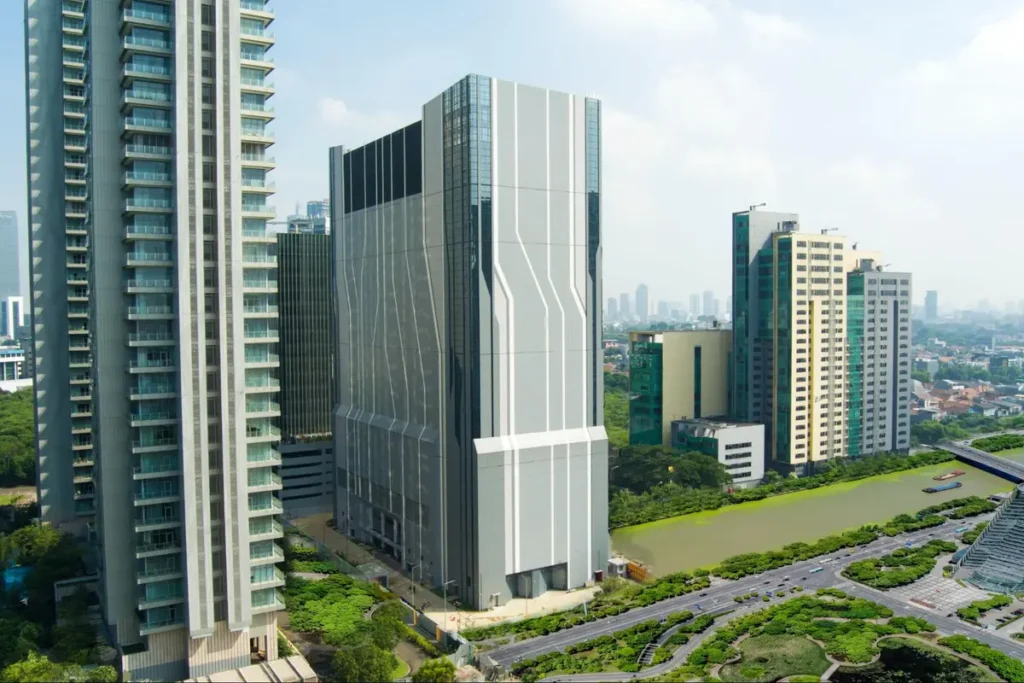
To support this growth, modern facilities such as EDGE2 by Digital Edge Indonesia offer large-scale infrastructure in central Jakarta, with 23MW of power capacity and space for more than 3,400 racks. EDGE2 also reflects the industry’s move toward green data center innovation, achieving a highly efficient Power Usage Effectiveness (PUE) of 1.24.
5 Key Reasons to Choose Colocation in Central Jakarta
When evaluating infrastructure options as part of a digital transformation strategy, colocation in central Jakarta offers a compelling mix of flexibility, performance, and scalability. Here are five of the biggest advantages.
1. Proximity to Users and Lower Latency
Latency is one of the biggest challenges in digital business. Choosing a data center where location and latency matter means placing infrastructure closer to your users, applications, and business activity. In Jakarta, latency can be below 1 millisecond for many local routes, compared with around 11 milliseconds when using infrastructure in Singapore. That difference can be critical for performance-sensitive workloads.
Lower latency supports faster user experiences, smoother application performance, and better responsiveness for time-sensitive systems. It also offers practical operational benefits, allowing IT teams to reach the facility more easily for maintenance, upgrades, or urgent interventions.
2. Strong Connectivity Through Fiber Networks and Internet Exchanges
A data center’s value is closely tied to the strength of its connectivity. Central Jakarta offers access to a broad range of fiber providers and network carriers, helping businesses build resilient and flexible interconnection strategies. High-capacity fiber infrastructure supports secure, high-speed data transmission with minimal disruption.
This connectivity advantage is strengthened by proximity to major traffic exchange points such as Indonesia Internet Exchange and Edge Peering Internet Exchange (EPIX). Businesses can also benefit from carrier-grade connectivity from enterprise internet providers, improving network diversity and reducing dependency on any single route or operator.
3. Reliable Premium Power Availability
Even the most advanced digital infrastructure depends on stable electrical power. As AI, cloud, and high-density computing grow, energy challenges in data centers become more important than ever. Jakarta benefits from mature utility infrastructure supported by multiple sub-systems, helping reduce the risk of power interruption.
Digital Edge Indonesia strengthens this further through Premium Platinum service from PT PLN. This setup provides electricity from two separate sources supported by an Automatic Change Over (ACO) system, which can switch to a backup source automatically if the primary source is disrupted. This adds an extra layer of business continuity for critical workloads.
4. Physical Security and Environmental Resilience
Data center security goes beyond cyber defense. It also includes physical protection, environmental resilience, and operational reliability. Businesses evaluating different data center services for enterprises need to consider both digital and physical risk factors, including fire, flooding, and other environmental threats.
While flood risk is a common concern in large urban areas, well-planned facilities in Jakarta can mitigate that risk through location selection, engineering standards, and infrastructure design. This makes central Jakarta a viable and secure option for critical workloads when the right facility is chosen.
5. Flexible Scalability for Business Growth
Digital growth is often unpredictable. Traffic surges, seasonal demand, new product launches, and rapid user acquisition can all place sudden pressure on infrastructure. Colocation allows businesses to scale more quickly without the capital expense and complexity of building their own facilities.
Instead of being limited by on-premise space or power constraints, organizations can expand rack capacity, bandwidth, and deployments as needed. This flexibility is especially valuable in a central business location where access to connectivity, talent, and support services is already established.
How Latency and Connectivity Affect Business Performance
Latency and its impact on digital services is not just a technical concern. It directly affects revenue, customer experience, and operational efficiency. Lower delay and stronger connectivity can improve business performance in several important ways.
1. Operational Efficiency
Businesses that rely on real-time data, such as supply chain operations, analytics platforms, and financial systems, are highly sensitive to delay. Slow data retrieval or delayed processing can disrupt workflows and reduce decision quality. Fast, reliable infrastructure helps organizations respond more accurately and operate more efficiently.
2. User Experience
Users expect speed. Research shows that 47% of users expect a website to load in two seconds or less. Even a one-second delay can reduce conversions by 7%. Better connectivity and lower latency help businesses deliver the responsive digital experiences customers expect.
3. Competitive Advantage
For services that depend on real-time performance, such as video conferencing, online transactions, streaming, and gaming, speed and stability are major differentiators. Throughput and latency directly influence whether users experience lag, buffering, or service interruption. Faster and more consistent infrastructure helps brands stay competitive in crowded digital markets.
How Different Industries Benefit
With access to advanced facilities like EDGE2 in Indonesia, multiple industries can strengthen performance, improve reliability, and scale more effectively.
1. Financial Services and Banking
Banks, payment providers, and fintech platforms need secure, highly available infrastructure for real-time transactions and customer-facing applications. Low-latency, highly connected data center infrastructure in Jakarta supports faster processing and more dependable service delivery.
2. E-Commerce and Retail
Online shopping platforms depend on fast page loads, smooth checkout experiences, and real-time inventory updates. Reliable data center infrastructure helps support high traffic volumes, especially during peak campaigns and promotions.
3. Cloud Services
As more organizations shift workloads to the cloud, proximity to customers and strong network interconnection become more important. Well-connected infrastructure in Jakarta allows cloud providers and hybrid IT environments to deliver stronger local performance.
4. Gaming and Entertainment
Online games and streaming platforms require speed and stability. Lower latency reduces lag, while strong connectivity helps prevent buffering and service interruptions. This creates a better experience for players and viewers alike.
5. Technology Innovation
Workloads involving AI, IoT, machine learning, and big data require fast processing and efficient data movement. Modern data center infrastructure supports these needs with scalable power, interconnection, and low-latency performance.
The Strategic Role of Colocation in Jakarta
Colocation continues to gain traction because it gives businesses access to enterprise-grade infrastructure without the cost and complexity of building their own facilities. As organizations grow more digital, colocation in Jakarta offers a practical path to performance, resilience, and expansion.
The importance of connectivity is especially clear in colocation services in Jakarta, where network quality, carrier options, and interconnection directly affect service outcomes. For many businesses, colocation offers the right balance of control, efficiency, and scalability.
Conclusion
Choosing the right infrastructure location can have a major impact on digital performance, customer experience, and long-term business growth. Jakarta offers a strong combination of low latency, dense connectivity, power reliability, and ecosystem readiness, making it one of the most strategic places in Indonesia for digital infrastructure deployment.
For businesses looking to support modern workloads, reduce latency, and scale with confidence, a centrally located data center in Jakarta is more than a technical asset. It is a strategic advantage.
To learn more about how our infrastructure can support your organization, explore what a data center is and its benefits, discover Digital Edge Indonesia’s data center solutions, or visit the Digital Edge Indonesia to connect with our team.