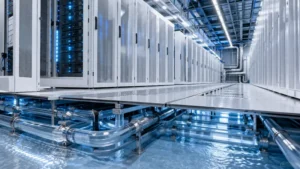
Data centers are the heart of the digital era, supporting vast information networks and driving our daily lives. As the demand for faster, more reliable, and scalable connectivity increases, traditional methods of managing data centers are undergoing a transformative shift. The multi-cloud strategy has now become the standard for achieving innovation, but it raises new challenges regarding how to connect various services securely and cost-effectively.
Cloud Exchange plays a crucial role in this shift because it provides a more direct connection path to various cloud platforms. In a broader interconnection strategy, internet exchange services are essential to reduce latency and make traffic more efficient, while a comparison of EPIX and IIX can serve as a relevant reference to understand the differences in available traffic exchange models.
Understanding Cloud Exchange
Cloud Exchange, also referred to as Cloud Interconnect or Cloud Connect, is a connectivity service that allows businesses to establish direct, secure, and high-speed connections to Cloud Service Providers (CSPs) and other data centers.
Simply put, this service acts as a “private toll bridge” connecting your IT infrastructure directly to multiple cloud providers. Instead of navigating the congested and unpredictable “highway” of the public internet, this service facilitates dedicated connection paths within carrier-neutral data centers that serve as unified meeting points.
Here is how Cloud Exchange plays a crucial role for businesses in Indonesia:
1. Direct Connection to Cloud Service Providers (CSPs) and Cost Efficiency
Cloud Exchange facilitates dedicated connections to multiple CSPs, providing greater bandwidth flexibility compared to connecting directly to individual CSPs. Operationally, data transfer costs (data egress) from cloud providers can be very expensive when using the public internet. Cloud Exchange often offers lower and predictable rates, significantly saving costs. Learn more about Indonet’s HSX Cloud Exchange which can improve your workplace productivity.
2. Seamless Multi-Cloud Connectivity
Modern data management often involves an explosion of multi-cloud adoption, where businesses utilize services from various providers (e.g., AWS for computing, Google Cloud for analytics). Cloud Exchange consolidates all these connections and allows businesses to seamlessly manage resources across different environments, providing flexibility and avoiding vendor lock-in.
3. Improved Network Performance and Low Latency
Sectors such as fintech, e-commerce, and digital media rely heavily on speed. Cloud Exchange significantly improves network performance by eliminating public internet bottlenecks. Real-time transactions and video streaming analytics run much faster because these dedicated connections ensure uninterrupted data transfer, meeting the specific needs of time-sensitive applications.
4. Enhanced Security and Compliance
With increasingly strict data sovereignty regulations in Indonesia, Cloud Exchange establishes private and isolated connections that reduce exposure to public cyber threats. This is highly beneficial in meeting high-level data compliance requirements for businesses in heavily regulated industries.
Key Differences: Cloud Exchange vs. Public Internet Connection
To provide a clearer picture, here is a comparison of infrastructure performance through Cloud Exchange versus the regular internet:
| Feature | Public Internet Connection | Cloud Exchange |
|---|---|---|
| Performance | Variable, prone to bottlenecks, unpredictable | Stable, low latency, high throughput |
| Security | Vulnerable to public cyber threats and exposure | Private and isolated connection, highly secure |
| Cost | High and fluctuating data transfer (egress) costs | Predictable rates, cost-effective for large data volumes |
| Reliability | No SLA (Service Level Agreement) guarantees | Backed by SLAs for uptime and high performance |
The Role of Data Centers and Internet Exchanges
Cloud Exchange does not stand alone; its success depends on the physical infrastructure ecosystem.
Data centers like EDGE1 and EDGE2 in downtown Jakarta serve as interconnection “hubs” where networks and cloud providers converge. While Cloud Exchange connects you to the cloud, Internet Exchanges like EPIX connect traffic to end-users through local peering. The combination of both creates a comprehensive interconnection strategy.
Conclusion
The evolution of the data center connectivity landscape pioneered by Cloud Exchange Indonesia is transforming how businesses manage their multi-cloud workloads. It is no longer just a luxury, but a strategic necessity to maximize application performance and reduce egress costs.
In Indonesia, providers like Digital Edge Indonesia demonstrate how such interconnection services are implemented. With a rich ecosystem of network providers and direct access to both cloud platforms and internet exchanges, organizations are well-prepared for a digital future that demands high flexibility.
Talk to the Digital Edge Indonesia Expert Team
Ready to simplify your multi-cloud connectivity? Contact the Digital Edge Indonesia expert team today for a consultation on how we can optimize interconnection and data center strategies for your business.