

Have you ever noticed that when you stream movies, some videos buffer longer while others load much faster? Can you guess why, even though both movies are on the same streaming platform, the buffering time can still differ? Even if your home internet bandwidth is sufficient, this issue can still occur.
Let’s take a deeper look into CDN and how data propagation works. This case study examines what changed when a global operator deployed a CDN PoP in Jakarta instead of serving Indonesian users from abroad.
What is Propagation?
At its core, the internet is simply a massive interconnection of networks. These networks are tied together through terrestrial and subsea fiber optic infrastructure spanning across the globe, from the western edge of Alaska to the eastern islands of Indonesia. As long as a region is connected through fiber infrastructure, internet access becomes possible. While we can argue that low orbit satellites have expanded internet connectivity to previously underserved areas, the global internet remains overwhelmingly dependent on terrestrial infrastructure. TeleGeography reported that approximately 97–99% of international internet traffic is carried through terrestrial and subsea fiber-optic cable systems.
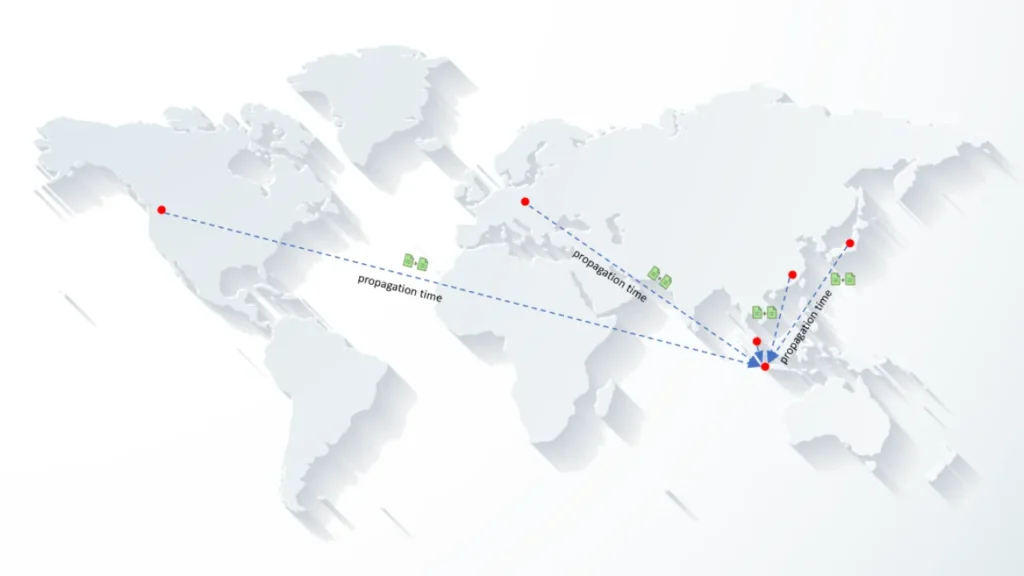
Whenever you access a website, stream a movie, or download a file, data must travel from the origin server toward your local network.
This process is called propagation.
Propagation refers to the first time a data packet travels from the data center hosting the origin server to the nearest data center where the content can then be distributed to end users. The farther the origin server is from you, the longer the propagation delay will be.
For example:
| Scenario | Typical Latency |
|---|---|
| Jakarta user accessing US server | 180–250 ms |
| Jakarta user accessing Jakarta cache node | 5–20 ms |
Over time, many content providers have evolved their strategies to improve customer experience. They aim to reduce latency by bringing content closer to users through CDN deployments.
After all, if a movie takes too long to buffer, you might skip it and switch to another streaming provider, right?
The Rise of Cache Nodes
Content providers are pushing more and more data to be stored in data centers close to their end users, especially when the data is frequently accessed. This could be a purpose-built data center or small server rooms owned by ISPs in a particular area, which we call cache nodes.
When the data is stored in a local data center, end users can experience faster buffering. Propagation only happens once, the first time the data is sent from the origin server. The next time you access it, you are accessing a cache.
Case Study: Deploying a CDN PoP in Jakarta
The customer is a global CDN operator with over 210 points of presence (PoPs) distributed worldwide across six continents.
Prior to this project, Indonesian traffic was primarily served from the customer’s Singapore PoP. While Singapore remains one of the region’s most important internet hubs, serving Indonesia remotely introduced several operational and performance challenges as traffic volumes continued to grow.
As more Indonesian consumers adopted high-definition streaming, mobile gaming, cloud applications, and digital services, customer expectations around performance also increased.
The CDN recognized that continuing to serve Indonesia solely from Singapore would eventually limit both technical performance and future growth.
The Results: What Changed After Deploying a CDN PoP in Jakarta
Within months of deploying a CDN PoP in Jakarta and optimizing interconnection, the operator observed significant improvements.
After Localization
Performance Improvements
- Latency reduced by up to 80% on key routes
- More stable performance during peak traffic periods
- Fewer buffering incidents
- More consistent HD and high-resolution video delivery
Network Efficiency Improvements
- Majority of Indonesian traffic served through local delivery paths
- Reduced reliance on international transit
- Lower cost per GB delivered
- More predictable routing behavior as the CDN has full control of it
Commercial Improvements
- Lower international transit cost
- Improved user engagement metrics
- Better positioning for gaming workloads
- Greater pricing flexibility through delivery efficiency
The company effectively moved from serving Indonesia remotely to operating as a localized content delivery platform within Indonesia.
Before vs After
| Metric | Before | After |
|---|---|---|
| Delivery Location | Singapore | Jakarta |
| Latency | Cross-border dependent | Up to 80% lower |
| Peak Hour Performance | Inconsistent, highly dependent on the upstream | More stable |
| Video Quality | More buffering | Improved QoE |
| International Transit Cost | Very high | Lower |
| Routing Efficiency | Indirect paths with a lot of uncertainty | Direct peering via IX or PNIs, more predictable |
In many ways, the evolution of CDN reflects the evolution of the internet itself. What once began as a mechanism to accelerate websites and reduce buffering has now transformed into a critical foundation for modern digital infrastructure.
Whether it is a movie stream, an AI workload, a factory sensor, or an autonomous machine making split-second decisions, the underlying principle remains the same: the closer the data is to the user, the better the experience becomes.
The lesson from this CDN PoP in Jakarta deployment is that the future is not merely about building larger centralized data centers somewhere far away. It is about building a highly interconnected ecosystem of edge infrastructure that quietly moves closer and closer to where people, devices, and data actually exist.