2026 Data Center Trend Forecast Series – Part 4 of 4
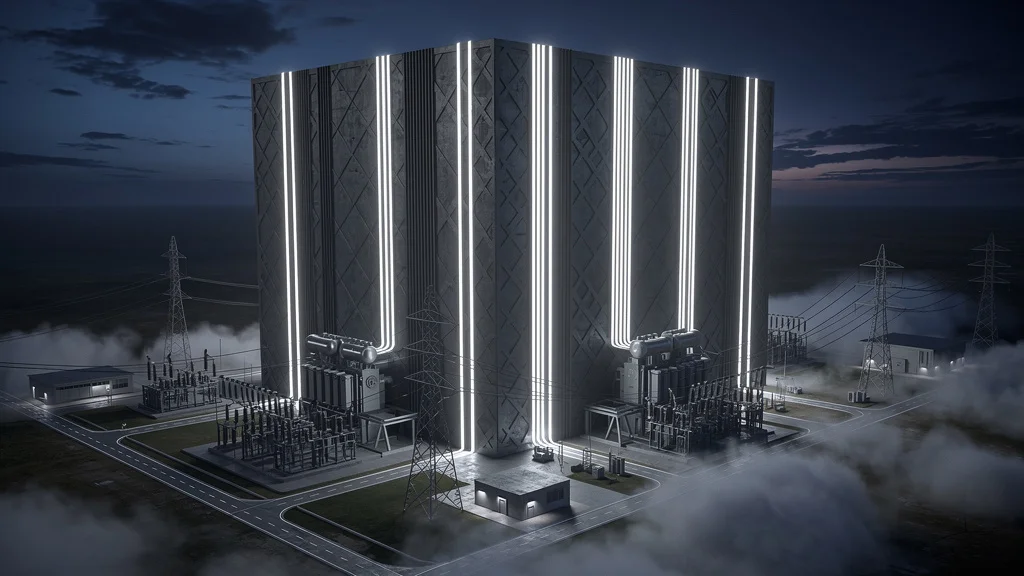
Over the last decade, the tech industry has become accustomed to the term hyperscale as the backbone of cloud computing. However, the explosion of generative artificial intelligence has forced this industry to evolve faster than expected. We are now leaving the era of conventional data centers and entering the “Mega-Hyperscale” phase, often referred to as the AI Superfactory.
The main difference lies in energy density and workload characteristics. While traditional cloud serves millions of separate, small requests, AI requires hundreds of thousands of chips working simultaneously as one giant brain. This fundamentally changes how these facilities are built and operated.
What Is an AI Superfactory and How It Differs
By definition, an AI Superfactory is a data center facility designed specifically to train a single massive artificial intelligence model, rather than just storing data or running web applications.
Unlike traditional cloud data centers consisting of thousands of independent servers, an AI Superfactory connects tens to hundreds of thousands of graphics processing units (GPUs) into one giant computing cluster. In this facility, the entire building functions like a single supercomputer. The goal is to minimize data latency between chips and maximize power efficiency for intensive machine learning processes.
Infrastructure Challenges Behind Generative AI Training
To understand this massive scale, we can look at what is happening with the world’s largest tech players today. Training a single cutting-edge AI model now requires facilities built with unprecedented speed and capacity.
For example, xAI’s “Colossus” supercomputer facility in Memphis was built in just 122 days to house 100,000 GPUs, which is now expanding towards 200,000 units. This scale creates such a huge and sudden energy demand that developers had to use independent power generation because the local grid could not supply the additional power instantly.
On the other hand, the main obstacle for the industry right now is no longer chip availability, but rather power socket availability. A Microsoft executive even revealed that they have thousands of sophisticated GPUs sitting in warehouses because there isn’t enough power capacity ready to turn them on. This proves that in the AI era, electric power is the most valuable commodity.
The 100MW Campus as the New Industry Standard
Previously, facilities with a capacity of 30 to 50 Megawatts (MW) were considered large hyperscale campuses. However, due to the energy-hungry needs of AI training, the definition of “large” has shifted drastically. Modern facilities are now designed with targets of hundreds of Megawatts up to Gigawatt scale in a single campus location.
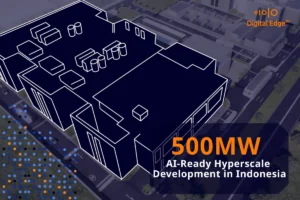
This shift in standards is happening globally, including in Asia. Infrastructure providers are now racing to build jumbo capacity to accommodate the wave of regional AI demand. As an illustration, Digital Edge DC is actively developing facilities with capacities above 100MW to 300MW in several countries such as South Korea, India, Indonesia, and Thailand. Readiness to provide infrastructure on the scale of hundreds of megawatts has now become an absolute requirement for data center players who want to remain relevant in the global market.
Technical Revolution in Handling Heat and Extreme Density
The shift to the “AI Superfactory” also fundamentally changes the technical specifications inside the building. Traditional server racks for web applications usually consume only 5-10kW of power. Conversely, modern AI racks containing the latest generation chips like NVIDIA Blackwell can consume more than 100kW per rack.
The implications for cooling systems are enormous. Conventional air conditioning (AC) is no longer adequate to handle the heat generated by such high density. Future facilities must now adopt liquid cooling technology directed straight to the chip to maintain optimal computing performance.
Conclusion
The direction of data center development is very clear. We are transitioning from mere data storage facilities to digital intelligence generation facilities. In this Mega-Hyperscale era, data centers are no longer viewed just by their building square footage, but by how large and reliable their power supply is. The winners in this AI race will not be those who just have the best algorithms, but those who possess the most robust physical infrastructure to run them.