In the current era of Artificial Intelligence (AI), almost all our digital activities—from streaming 4K video, financial transactions, to running complex generative AI applications like ChatGPT—depend on data centers. But what exactly is a data center? Understanding the definition of a data center is the first step to recognizing the infrastructure that forms the “brain” of the modern digital world.
The explosion of AI usage has drastically changed the landscape. While in 2023 there were 5.3 billion internet users globally, the demand for power is now skyrocketing. According to the International Energy Agency (IEA), electricity consumption from data centers, AI, and the cryptocurrency sector could double by 2026. This figure indicates the massive volume of data and computing power required to support future technologies.
This guide will comprehensively explain the definition of a data center, its functions, key components, and its evolution toward hyperscale.
Definition of a Data Center
Simply put, a data center is a centralized physical facility used by organizations to house, process, and manage their critical data and applications. A data center is a technological ecosystem designed to ensure data and services are always secure, available, and accessible whenever needed.
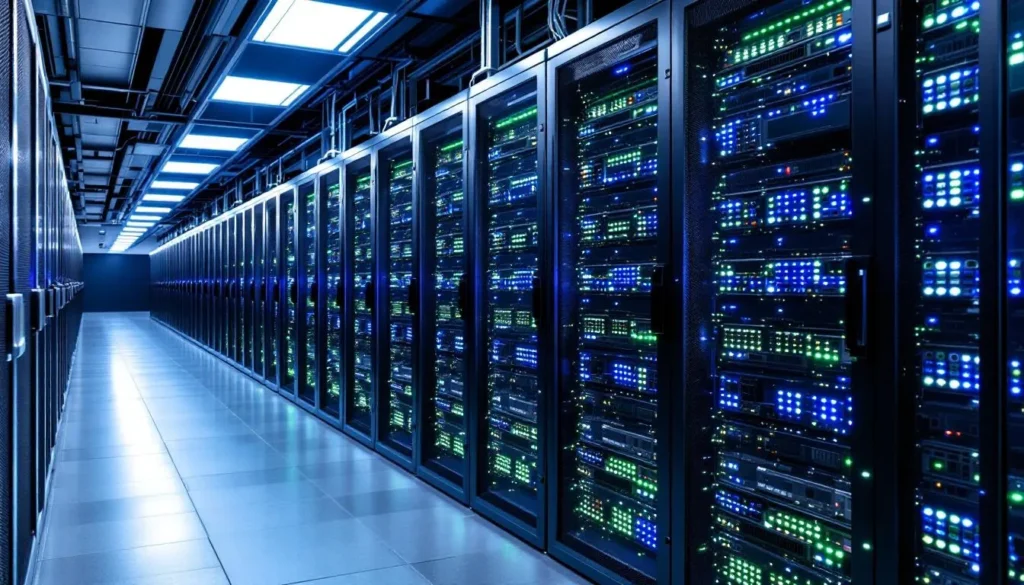
This facility serves as the hub of IT infrastructure, housing various components such as servers, storage systems, and network devices. Tech giants, cloud service providers, and AI developers heavily rely on data centers to train intelligent models and run their daily operations.
Why is a Data Center Crucial Infrastructure?
In the era of digital transformation and AI, the data center has become more than just a storage facility; it is a modern computing factory.
Enabling AI Innovation
Modern AI applications require immense computing power for training and inference. Data centers provide the high-density infrastructure needed to process these complex algorithms in the shortest time possible.
Business Continuity
Modern businesses cannot tolerate downtime. Data centers are designed with redundant systems for power supply, cooling, and networking to ensure business operations run uninterrupted, even when servers are under heavy load from AI processing.
Data Security and Regulatory Compliance
With increasing cyber threats, data centers offer layered security (physical and digital) to protect sensitive data and intellectual property, while helping companies meet strict global regulatory compliance standards.
Efficiency and Scalability
As businesses grow, data centers allow companies to quickly and flexibly add or reduce computing resources. Services like colocation allow companies to deploy high-performance AI servers in facilities equipped with advanced cooling and power, converting capital expenditure (CAPEX) into more efficient operational expenditure (OPEX).
Key Functions of a Data Center
Data centers have several crucial functions that support overall business operations.
Data Storage and Management
The most fundamental function is to store massive volumes of company data (Big Data) securely, centrally, and in a structured manner for easy access and analysis.
High-Performance Computing & AI
Data centers now house thousands of servers equipped with AI accelerators (such as GPUs and TPUs). This function is vital for performing the massive parallel calculations required for heavy graphics processing, predictive analysis, and machine learning.
Networking and Connectivity
This facility serves as a central hub for digital communication networks, facilitating high-speed data transfer between servers, storage systems, and external networks like the internet with minimal latency.
Disaster Recovery
Data centers play a vital role in disaster recovery strategies. By providing infrastructure for backing up data and systems, business operations can be quickly restored in the event of a system failure or natural disaster.
Components and How a Data Center Works
To handle heavy AI workloads, data center components have evolved to become more sophisticated.
Servers (CPU & GPU)
These are high-performance computers acting as the “brain.” For AI workloads, modern servers are not just powered by standard CPUs but are packed with Graphics Processing Units (GPUs) or Tensor Processing Units (TPUs) to handle thousands of mathematical operations simultaneously.
Storage Systems
High-speed hardware devices like NVMe SSDs are used to store the massive datasets needed to train AI models, ensuring data is fed to processors without bottlenecks. These often use RAID configurations for protection.
Networking Equipment
Devices like routers, switches, and firewalls form the central nervous system, managing traffic flow to ensure high bandwidth and low latency essential for AI applications.
Supporting Infrastructure
These are the life support systems, which include:
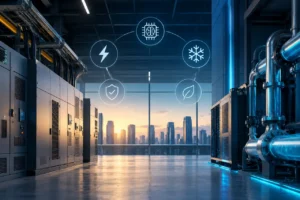
- Electrical Power: Uninterruptible Power Supply (UPS) systems and backup generators. AI data centers require much higher power density per server rack than traditional ones.
- Cooling Systems: Devices that maintain optimal room temperature (usually between 15-25°C). Modern facilities are moving toward Liquid Cooling technology to efficiently manage the intense heat generated by AI chips.
- Physical Security: Layered defense systems including CCTV, biometrics, and 24/7 security.
Types of Data Centers
As computing needs become more specific, the types of data centers have evolved.
Hyperscale Data Center
These are massive facilities designed for extreme scalability. Hyperscale data centers typically house thousands to millions of servers working in concert. These facilities serve as the backbone for tech giants (Big Tech) and global AI platforms to handle massive data volumes. Industry data suggests that hyperscale capacity is expected to almost triple in the next six years, driven largely by AI demand.
Colocation Data Center
In this model, companies lease space, power, cooling, and security from a professional provider (“the host”). Companies still own and manage their servers but house them in the provider’s world-class infrastructure. This is ideal for enterprises wanting to deploy AI infrastructure without building a facility from scratch.
Cloud Data Center
These are massive facilities owned and operated by public cloud providers (AWS, Azure, Google Cloud). Customers lease computing resources virtually over the internet, paying based on usage without managing physical hardware.
Edge Data Center
These are smaller facilities located closer to where data is consumed or generated. The goal is to minimize latency (delay) for real-time applications such as autonomous vehicles, smart cities, and onsite AI inference.
Read Also: Evolution of Colocation Data Centers: Why Are They Important?
The Future of Data Centers
Data center technology continues to evolve to keep pace with AI innovation.
AI-Ready Infrastructure
Future data centers will be “AI-Native,” designed with a focus on high power density and rack architectures capable of supporting heavy GPU servers and integrated liquid cooling systems.
Hybrid and Multi-Cloud Solutions
Many companies are adopting hybrid architectures (combining colocation for sensitive data and public cloud for flexibility) to create the most efficient infrastructure in terms of cost and performance.
Green Data Center
Given the massive energy consumption of AI, there is a strong global push for environmentally friendly operations. This includes using renewable energy, integration of AI in data center operations to optimize efficiency, and reducing the carbon footprint.
Read Also: Green Data Center: The Future of Sustainable IT Infrastructure
Conclusion
So, a data center is the irreplaceable foundation of the modern digital economy. More than just a building full of servers, this facility is the “powerhouse” for the ongoing AI revolution.
By choosing the right data center strategy—whether hyperscale, colocation, or edge—organizations can ensure they have the resilient infrastructure needed to innovate and compete in the future.
Interested in reliable and efficient data center solutions? Visit Digital Edge Indonesia to learn how we can support your digital infrastructure needs.